
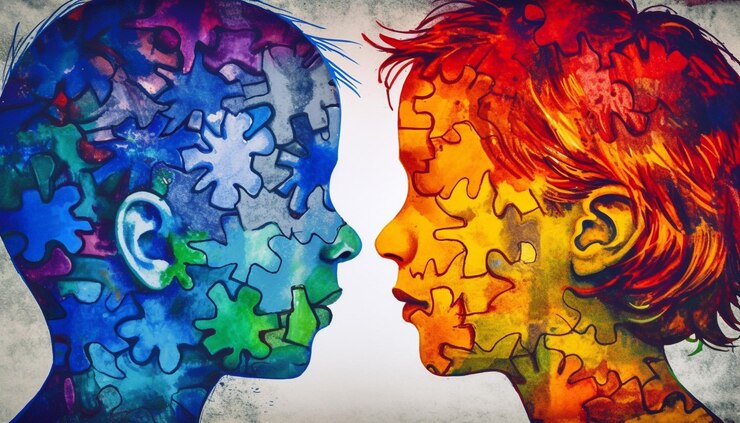
When a group of people share neurodivergence in common, that doesn’t necessarily mean they are all the same or even relate to each other that well…very far from it…since as the saying goes, when you have met one autistic person you have met one autistic person; we are all divergently divergent, being each divergent in our own particular ways.
When you put that mix of qualities together in a family or friendship setting it can result in its own kind of “dynamic bomb”, not least at times of increased social pressure such as Christmas. I now realise (better late than never) what kind of impact this has had on my life, not least as the trigger of some of the most profound hurts and confusions of my childhood…all arisen from storms in teacups that seemed to upset me to an exaggerated degree; also the considerable impact it continues to have these days (if I let it…this is where increased awareness serves as the best kind of disarmament device) at times when family members spend more than usual time together, as now.
As I sit back to spectate, yet again, what typically plays out each time (yes, my a-typical family has its own version of typical…), informed as I now am with the knowledge of neurodivergence running strongly, in various forms, throughout the entire family group, missing as that knowledge was from my earlier life (imagine, I used to assume we were all completely normal, wondering why we didn’t conform to any stereotypes I had ever encountered, haha ), this is making for an interesting spectacle, if no less frustrating than it usually is. I can’t help wondering if any other readers from neurdivergent backgrounds can relate to some of the scenarios and play-offs I am about to describe.
For instance, if there is a person in your group dynamic that lacks filters or brakes, an autistic/ADHD trait that is fairly well documented, that will always make for a strong incitement of emotional chaos in the wider group.
My husband is particularly that person (and, by the way, I also admit it can be me…more on that later) and, whilst he is often the life and soul of a gathering because he can be confident and funny when the rest of us clam up, his lack of ability to filter whatever happens to occur to him in the moment, combined with a total inability to stop once he has got started, will often create havoc in a social situation that is already precarious due to mixed type neurodivergence going on.
For years I have tried to be on the ball enough to signal to him when its inappropriate to continue saying something or when that thing is only going to turn tables on the happy dynamic in the room but he doesn’t seem to be able to grasp quickly enough to follow through, or, there is an abject stubbornness in him that refuses to respond to instruction, a kind of demand avoidance in action, which is a very active trait of his (I suspect a bit of both). This rubs badly against, for instance, anyone with anxiety, particularly rejection sensitivity and especially anyone prone to take things far too literally. The neurodivergent females of the group do seem to be so painfully sensitive as to be the touch paper that any over-bluntness thrown in the face of their tenderness or a cheap moment’s humour at the expense of hours of over-analysis after the event will inevitably be; a whole evening suddenly turned inflammatory, miserable and sour because of something that an unfiltered person blurted out of their mouth “unthinkingly” and that was perhaps best left unsaid or as a private joke not shared with the target of it!
I too am that painfully hypersensitive neurodivergent female who will take things in very deeply and hyperfocus on them to the nth degree after the event but, thankfully, when it comes to my H, I seem to have developed a very thick skin or the ability to let his humour slide off as the harmless work of a moment, not some premeditated attack that I am meant to take seriously. He is a fundamentally kind person and never means harm by what he says, admitting freely that it’s a kind of blind spot.
To me, his version of blunt, unfiltered humour is nothing compared to the actually malevolent attacks of a previous partner I put up with for over a decades and I do sort of “get” his need to follow the flow of his humour, this being one of his special interests (I think we autistics all get how unstoppable we can be when it comes to managing those). This factor leads to a total inability to put the brakes on something he is enjoying the intellectual process of…because, for him, humour is a form of brain game and hyperfocus once he gets into the flow of it and, like any specialist interest, compels him to follow through on the witty machinations of his mind until they are sated (unfortunately, outloud). I’m also aware that humour energises him and is one of the few ways he can remain engaged with a social dynamic, otherwise he gets bored and quickly zones out.
I can also relate because I have my own version of blunt delivery, being a high propensity to speak “truth” when it comes to what I am really thinking. I really struggle…ever more with age…with dressing things up when that loses me the authenticity of what I really mean but this can act like a detonator in a social situation, even amongst those I would like to think know me best and who, I would hope, appreciate what would be the profound cost to me of reneging on my personal truth after the long battles it has taken to get to it.
By the way, on the topic of special interests and/or hyperfocus (the latter can also be an area of worry that knows no rest) these too can add their own painful effect upon the group dynamic as there are one or two individuals (and I confess, I can sometimes be one of them) who either get into a deep groove of talking…borderline obsessing…about their fixation of the moment, overtalking anyone who tries to interject and/or who zone out completely when the conversation is not on that topic (I come from a long line of interrupters and highly opinionated hyperfocusers, people who just have to have the last word even when discussing a matter of opinion, which can be “fun” when all put together in a room).
However, returning to topic, I also empathise, and painfully so, with the most sensitive of those my H sometimes affects when he is unfiltered as I can so minutely relate to how he gets under their wire or unwittingly hurts with things which, if taken as black and white, may sound horrific to the kind of recipient who has no ability to perceive that these words are not real or literal, just a funny performance for performance’s sake. In effect, what plays out is a case of two types of neurodivergence in direct collision with each other. As the one caught in the middle, and as someone who can’t help but spend a huge amount of effort checking-in that everyone in the group is always happy and has what they need (this is one of my big neurodivergent quirks as I am a natural born peacekeeper and almost don’t know how to be relaxed unless everyone else is alright first), I am then left floundering in a sea of conflicted feelings to do with not being able to go to one person’s assistance without apparently criticising or standing against the other person (taking sides has always been something that causes me agonies of the highest order as I can’t bear to abandon one party in the name of another…).
This feeling of being stretched in all directions, of the sheer trauma of being unable to fix everyone’s problems, is really one of my oldest historic wounds stoked up again; one that caused a massive amount of my childhood grief and misery due to living in a highly neurodivergent family that always seemed to be as much in a state of heated loggerheads with each other as it was a-typically cohesive in a way that some of my friend’s families clearly weren’t (there has always been something paradoxical about the way we are both conflicted yet incredibly close; perhaps because we learned to stick together as a pack due to our apparent differences from everyone else). Back then, I just took every fall-out way too seriously, feeling like it always was my problem to fix (and my failure when I couldn’t…) and I notice the same trend in me today, adding spade loads of stress in every social situation that doesn’t go as smoothly as it could have!
Other members of my family also share the unfiltered or very blunt delivery of my H, though I have used him as the classic example, and these mostly tend to be the males (I had an uncle who was painfully so, with no idea how much upset he left in his wake, and my dad had more than his fair quota of this trait). Or, should I say, some of the females (including me) also share this bluntness thing but it is more often tempered by other sensitivities. One male family member is so ruthlessly blunt that I still buckle when he comes out with certain things a certain way, long after I should have learned better, and another is almost robotic in his apparent lack of sentiment, sending me into paroxysms of unnecessary pain at the sheer sparsity of his communication. At least I have finally come to know, if only the slow painful way, that none of this means that they don’t care, only that they don’t necessarily demonstrate this in the typical fashion!
The same with my H who cares very much; so much so that when I finally get through to him about the clumsiness of his ways (to protect some other person), he often shuts down and goes the other way; tight-lipped and silent, this is almost worst (to me) than his run-away train because it clashes so profoundly with my rejection sensitivity dysphoria. Nothing gets to me more than the silent treatment, whatever its source, and it quickly makes me paranoid, sad, even a touch on the traumatised side…even in situations I have been in before, which I know turned out alright yet while I am stuck inside the sudden silent-zone it seems to trigger my nervous system into an unavoidable state of terror, an outcome so ingrained and without override (try as I might) that I would rather the most upsetting scene in the world play out than this sudden shut-down behaviour that is his way of applying his own safety catch. Logical though his response may be, its not a good match for rejection sensitivity dysphoria which is a very real, impossible to negotiate with, mental state that can be very deeply painful for those who experience it.
As he often says to me afterwards, he either has to have absolute free range with his thoughts and what he wants to say outloud or the only way he can stop this is to shut down completely; in other words, he is either all on or all off, and I suspect this is a very common neurodivergent trait because I have it in other areas, beyond the social, so I know how it is when you feel there is no middle ground, no subtlety or moderation to be found, like it has been completely left off your dial. In his case, he doesn’t even seem to be able to try to get there; its a zone that doesn’t exist in his spectrum when it comes to social behaviour….which is fine when we are alone together, but a danger zone when we are with others who might take him more personally. Yet there is no point me punishing or blaming him; another layer of understanding that comes from seeing the neurodivergent trait at work being the acceptance that this is what is and not a wilful act of harm or defiance…just the way things are, as de facto as any other physical quality in a person. The only possible area for change is how those around him choose to respond (assuming that can be controlled either…rejection sensitivity is sometimes a hardwired trait of neurodivergence, not one you can easily be coached out of, and therefore often can’t be changed either).
So what makes me so much stronger at knowing what is “appropriate” or not to say out loud? I do suspect its down to my femaleness as its a well known trait of autistic females that we often don’t “seem” autistic because we are so good at masking and this is because so many of us become consummate studiers, thus mimickers, of other people’s behaviour. For my own part, I know I have spent an entire lifetime studying other people, to the very minutest degree, not to mention learning copious amounts from peoples’ behaviours in literature and television etc; its been the work of a lifetime and thus my understanding of social behaviours is extremely nuanced and advanced as a result; something which has served as the best possible masking device, though its not that I am pretending as I really do now have this high degree of ability when it comes to understanding how to behave.
All of this close observation, an area of hyperfocus in its own right, has taught me a very high degree of emotional intelligence because, combined with a painfully active degree of empathy (which, contrary to some opinions, can be a very strong trait of autism!) plus a very high degree of sensory sensitivity that enables me to directly feel when a person is responding adversely to something or the energy has changed in the room (highly developed mirror neurones or mirror touch synaesthesia), I have become pretty darned accomplished at knowing when a line is being crossed or something being done or said that would be better left well alone…with the proviso being that I also possess a very large blind spot when it comes to my own blunt delivery!
I also have a very strong tendency to run scenarios to their inevitable conclusions in my mind’s eye, virtually like videos, so I can often predict how badly something might play out, right to its bitterest conclusion…thus knowing when its a very good time to avert that outcome….a skillset my H clearly lacks based on his tendency to walk straight into the kind of endings no one really wants to get to!
So suddenly, last night, we found ourselves in a scenario where he had put his size nines in it again, another party was then hurt and upset because it hit on the nerve of their rejection sensitivity, I was alarmed and frustrated at not having succeeded to rein him on on time to keep my envisioned outcome of the evening intact, not to mention trying to pacify the upset person before it turned into dreaded drama, and he finished the evening by shutting down as the only way he knows how to stop, with me doubly upset that I was being apparently cold-shouldered before bed (my own rejection sensitivity now activated…) because he clamped shut for the rest of the evening.
I then struggle to bounce back from all that as I get into my own autistic groove of low-mood, especially if forced to sleep on the situation without resolve. This kind of intense, heavy emotion is like driving a juggernaut that I can’t easily turn around in the road so I am still stuck in a sort of moody shutdown mode today (hence hyperfocused on writing this post rather than engaging with anyone in the room). It’s as though all my social functions have dried up completely for now and I feel so chronically fatigued I can’t even describe. This flags up to me, for the umpteenth time, just how upset and affected my entire nervous system becomes when there is an unhappy feeling in the room; a classic symptom of being a highly sensitive empath and something which has caused me such a lot of emotional stress over all the years of living in a contrasty neurodivergent family.
I just can’t seem to cope with high emotional outbursts, whether they directly involve me or I am the bystander; they tear through my nervous system like a wild fire, inflicting damage that takes me a very long time to recover from, with my brain chemistry in disarray for days and, always, a shocking amount of actual physical pain as though I have been blown wide open into a mass of open wounds. Sometimes the sheer pain of aftermath from some family blowup can feel utterly unbearable, as though I can’t continue with my life; so I’ve had to come to rely on the healing effects of time to get past them since no amount of logic (my preferred method of reaching resolution) ever does.
I’m often left bewildered as to why some forest fire even happened yet utterly devastated by the collateral. When that cause is apparently me, my own bluntness or style of delivery, the pain of aftermath is all the more profound as I can’t bear to hurt or let people down but I also can’t continue to mask or be inauthentic any longer either, so I feel torn asunder by such powerfully opposite forces running through me. For years I made much more effort to “flower-up” what I said or give people what they wanted to hear the very way they wanted to hear it but, as I get older, especially with the burden of chronic illness to cope with, it just utterly exhausts me to continue any pretence, plus I have steadily lost the ability to mask the more I’ve come to realise the degree to which I used to do it and the terrible cost it used to have on my life.
Part of it, for me, is also the profound disappointment and sense of failure that a long-planned gathering turned sour for no good reason, in fact the most ridiculous of reasons in the book, a crossed wire or over-sensitivity that apparently couldn’t be over-ridden; for whatever reason my ideal of an outcome seemed to get into a tail spin and that was that. I put such a lot of effort into planning ahead, visualising what I want to happen and trying to create “perfect”, highly controlled outcomes that the merest feeling of chaos or of plans being thwarted throws me completely off my tracks and this is another painful iteration, I admit, of my autism!
I now look back and almost laugh (if only the memories weren’t so profoundly painful…) at how often a similar scenario has played out in my family or even certain friendship dynamics over the years, through any one of the various players (including me…) lacking filters coming into conflict with all the highly sensitive, rejection sensitive traits (also me…) in the mix. What often used to seem like terrible, dysfunctional family dramas in my childhood were really just different styles of neurodoversity playing out in the same small space and the realisation of this…and how such dynamics still continue to play out because we all, of course, continue to have the same neurodivergent leanings as we ever had…has helped to make them feel newly benign, if no less frustrating or tedious at the time they are happening. In no small part, this has been one of the reasons I so frequently suffer with social exhaustion…being not so much to do with having to mask, conform or make small talk with neurotypicals as coping with all the complex neurodivergent dynamics amongst those of us who are all very different, which is actually the larger part of all the people I tend to mix with!
An ever increasing awareness of our own particular versions of neurodiversity can only ever help with developing a more evolved way of responding in these social situations, helping us to gain a broader perspective of the dynamic at play, without always being caught-up in all the drama at ground level. Learning not to take things so personally is a very big part of this evolutionary process and, by necessity, any unusual or challenging dynamics at play need to be discussed more openly in order to shine a brighter spotlight on each of our unique corners of perspective in an effort to at least inform each other of our own particular weak spots and tender areas, even if we can’t necessary “fix” them. For instance, I was most grateful when my sister recently made a little speech about how she can’t cope with sarcasm at all as she takes it way too literally and it really hurts her as she overthinks it afterwards; because, without being told so, how could anyone know this, especially in a family where sharp wit has always been the house style. In announcing this she was, effectively, self-advocating and we all need to learn how to speak up and do that. Self-care needs to amp up in a way that it can only do with increased awareness of our own traits (for instance, being the life-long peacekeeper has been utterly exhausting for me…I need to watch out for just how draining that tendency can be in situations where I shouldn’t even be expecting myself to be the one to “fix” everything).
Acceptance is the final piece, being the point when we can finally accept that each of us is quite different, possessing traits we can’t so easily override (nor should we have to…) though perhaps knowing where they come into direct clash with others will help us to know how to curb or deflect some of the conflict and pain that inevitably results from assumption or oblivion. In these ways, I often find that neurodivergent folk are more open, thus able, to evolve and grow than neurotypicals because they are just so used to being the long suffering anomaly themselves that they tend to find it easier and more natural to be accepting of others quirks; at least some of the time, again with varying degrees from person to person (not always the case if they are prone to rigid black and white thinking).
If only we can use this openness trait to good advantage, if we have it, combined with big picture thinking, we can become not only much more self-aware (this can be helped by learning….as minutely as possible…everything we possibly can about our own presentation of neurodiversity) but also much more aware and accepting of the limitless array of differences borne out by the experiences of others.
Published on Living Whole by Helen White 1 January 24 https://living-whole.org/
 Neurosoma