
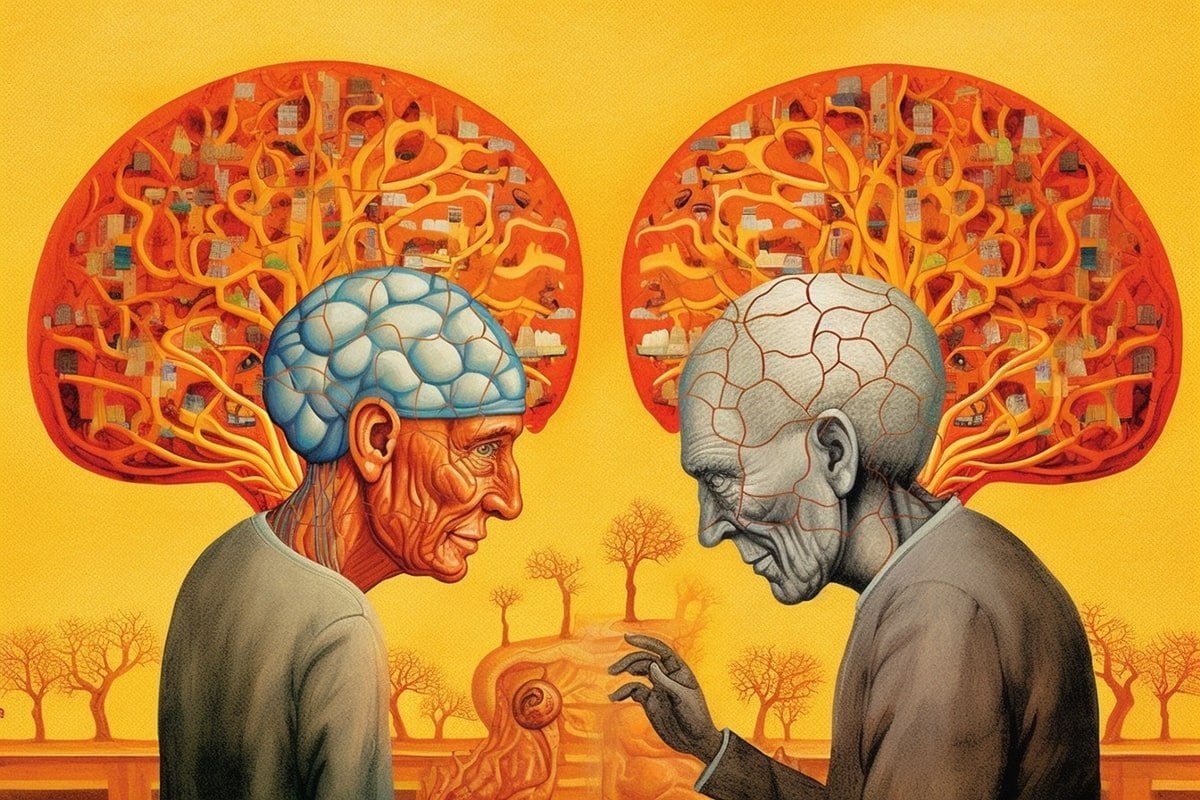
Across a human life span, changes in cognition are expected to occur as individuals grow older. Most of the changes experienced in aging are related to a decline in fluid intelligence, defined as the capacity to solve problems and articulate ideas, to navigate new situations, and to acquire knowledge. On the other hand, crystallized intelligence, defined as acquired general knowledge (e.g., vocabulary and procedures), is preserved for longer periods [1]. Moreover, during aging, other neuropsychological abilities are known to decline, such as attention, working memory, and episodic memory [2].
Some faculties related to crystalized intelligence might increase over time, such as general knowledge and wisdom [2]. And this amount of additional information, when integrated to crystalized intelligence, can become an advantage. On the other hand, the attentional and working memory decline, related to fluid intelligence, makes it more challenging to solve problems and articulate ideas.
Image studies have shown atrophy in white matter and gray matter, synaptic degeneration, blood flow reduction, and neurochemical alterations [3]. Those changes are more prominent at the prefrontal cortex; however, older adults that maintain their performance on pair with young adults tend to increase activation in order to keep performance, and this increased activation creates more hemispheric asymmetry in elderly than in youth. Consequently, Cabeza et al. [3] proposed a model called hemispheric asymmetry reduction in older adults (HAROLD), in which an older adult tends to compensate the neuropsychological decline with higher activation at the frontal cortex.
Cognitive training with the intent of increasing abilities and enriching neural networks has been a tendency since the 1960s, when the first behavior protocols sought to train memory using strategies of “chunking” (grouping information bits to be stored as single concepts) and using metacognitive strategies for dealing with complex information. Those strategies to enhance memory capacity were based in conscious and external mechanisms [4].
In the late 1980s, Baltes et al. [1] have demonstrated that older adults may benefit from cognitive training by creating reserve and increasing their performance in cognitive tasks. Afterward, many studies and protocols have been developed to provide cognitive training for the aging population. Some of them are related to strategy making, where the individual has to identify a difficulty level and naturally self-adjust. Reasoning, problem-solving, and goal management also have been used to enhance cognition. Multimodal approaches have also been tried, in which an unrelated task is trained in order to provide skill transfer (e.g., video games or cardiovascular exercise). Lastly, there is the process training, which includes a set of cognitive tasks to be trained heavily and specifically [5].
Recent technological developments have supported new forms of training, nowadays using tools such as computer games to enhance cognitive capacity [6] ie or neurofeedback brain training. Therefore, cognitive training has increasingly become a potential tool to aid healthy individuals with cognitive aging as well as patients with cognitive decline.
Training working memory—a component of the executive function—is one of the tendencies to enhance cognition and enrich neural networks [7], especially to form cognitive and neuronal reserve in aging people. Most of working memory training is based on computer game protocols, such as Cogmed [4], that might transfer the skill learned to other tasks [5, 8, 9].
Therefore, generally, executive function is trained by two interventional models: behavioral and neuroscientific. The behavioral model focuses on one’s acquired ability and trains executive function using computational tasks, with diverse protocols; the neuroscientific model by neuromodulation uses neurofeedback training or neuronal direct stimulation—direct current or magnetic current [10].
Transcranial direct current stimulation (TDCS) is a form of noninvasive neuromodulation based on a small current applied by two electrodes positioned in the scalp in order to create neuronal membrane excitability and enhance neuronal firing. Transcranial magnetic stimulation (TMS) is also noninvasive neuromodulation but instead based on a magnetic field applied to the scalp focused at target areas to create a neuronal action potential to induce firing. Both models provide neuroplasticity at the area applied and, consequently, benefit cognition [10].
working memory model
Working memory is a neuropsychological function that allow us to deal with daily information, such as keeping in mind a telephone number while dialing, organizing the mental operations to accomplish a task in hands, or listening and remembering a sequence of facts in a story in order to understand it.
Working memory can be described as a multimodal system, and Baddeley [11] defines it as a system of temporary storage under attentional control, encompassing our ability for complex thought and comprising diverse neuropsychological constructs. The abilities which working memory allows, although natural to most humans, require a complex cognitive model and several brain areas.
For about 50 years, working memory has been studied to define its main properties. The model adopted in this chapter is based on a construct of Baddeley and Hitch [12], in which working memory orchestrates information received through four components, one attentional and three mnemonic (Figure 1).

According to the Baddeley and Hitch model [12], the first component of the working memory is the central executive: an attentional control system that is connected to other three storage systems—the phonological loop, visuospatial sketchpad, and the episodic buffer. The episodic buffer component was included posteriorly [13] and all the components work interconnectedly. Further, each system is limited in capacity [14].
Briefly stating, the phonological loop is able to temporarily keep linguistic expression (e.g., verbal and emotional) and acoustic information, and the visuospatial sketchpad works similarly to the phonological loop, but only for visual and spatial information. Then, the episodic buffer acts as a mechanism that connects perceptual information from the two subsystems to long-term memory, integrating information into a limited number of episodes [11, 15]. Besides that, the phonological loop and the visuospatial sketchpad are considered two slave subsystems of the central executive, a system that accesses long-term memory information by attentional control [14, 15].
The central executive is responsible to keep information in mind while completing a task. Its proposed mechanism is based in frontal lobe patient studies that provided evidence from the connection between the supervisory attentional system (SAS), developed by Norman and Shallice [11], and the central executive [16]. Therefore, according to Baddeley [11], there are four candidates to compound the executive processes: the ability to focus attention, divide attention, change attention, and secure the connection between working memory and long-term memory.
The episodic buffer, completing this model of working memory, is responsible for temporary storage of perceptual information from both the phonological loop and visuospatial sketchpad, combining the information to form long-term memory content [13]. In conclusion, the function of working memory is to manipulate the information for a limited period of time, and it may increase or decrease in its capacity according to demand and practice [17].
executive function
The executive function consists of multiple top-down neuropsychological functions that enable us to deal with problem-solving in a non-automatic way. It may involve activities demanding attention, such as when writing and remembering a map on way to school [18], as well as activities demanding planning, controlling, and monitoring [19], such as keeping a diet prescription, physical training, or working long hours. All these abilities, also natural to most humans, again require a complex cognitive model that involves inhibition (including self-control), working memory, and flexibility.
Therefore, executive function has three neuropsychological functions associated with it. Firstly, there is inhibitory control, which is the ability to control internal and external stimulus that interfere with thought process while executing an activity that demands attention, filtering out the concurrent stimulus. Inhibition gives rise to what is commonly called self-control, an ability to prevent habits and instinctive behavior to dominate over careful planning [20]. Secondly, there is mental flexibility, which is the capability to alter between stimuli and adjust during the execution of a task in order to complete it [21]. Thirdly, there is a working memory, which has been described in the previous topic.
neurofeedback
Neurofeedback (NF) is a neuromodulation by operant conditioning of brain activity, where physiological signal is acquired by electroencephalogram (EEG), functional magnetic resonance (fMRI), or functional near-infrared spectroscopy (fNIRS), and a computational interface provides a feedback (visual or/and sound) to enable self-regulation [22].
The neurofeedback works dynamically in the cortex. For instance, when electrical activity is used as parameter, subjects can enhance a brain wave frequency in a region while reducing another brainwave frequency in another region. The Lacroix [23] cognitive model provides a broader view of NF training, as he proposes that a change in a subject’s perception of his physiological self-regulation provides a cognitive integration from the conditioned behavior. Consequently, neurofeedback involves a cognitive component associated with a conditioned behavior.
Additionally, the neuronal mechanisms of neurofeedback training are based in the neuromodulation model: the feedback provides a persistent functional brain reorganization and generates neuroplasticity, as pointed out by cortical changes after training in evidence-based studies, while those changes are ruled by a Hebbian learning process [22].
Electroencephalogram is the most common tool for neurofeedback, in which physiological information is collected and fed back to the same individual to induce self-regulation. EEG captures electrocortical activity and decomposes it into brainwaves. Generally it has four components: electrodes, an amplifier, a converter, and software. The electrodes often collect the electrocortical activity from layers III and V at pyramidal cells that occur close to the scalp.
The brain activity is characterized by the postsynaptic potential difference of billions of neurons and captures data closest to the scalp [24]. The potential difference forms a bidimensional (amplitude and frequency) topographic representation of the cortical activity that will be mathematically calculated by the Fourier transformation. Therefore, the Fourier transform makes a decomposition of sinusoidal signals from the cortical depolarization, forming the following frequency band waves: delta, 1–4 Hz; theta, 4–8 Hz; alpha, 8–13 Hz; beta, 13–30 Hz; and gamma, 30–60 Hz…
The voltage received by cortical electrodes is very low, around a thousand times lower than cardiac electrical impulse and hundred times lower than muscular activity. Despite capturing a low amplitude, there are further challenges in capturing brain wave signals: electrical information from brain waves must be excluded from many layers of interference, such as the skin, scalp, pia mater, and fluid, beyond external noises and electrical current from electrical apparatus.
Therefore, an amplifier and filter must be used to improve the signal [26]. The filters act by reducing noise, leaving mostly the biopotential desired to be converted; the amplifier amplifies the signal to a range of 100–100,000 times the information from electrodes [25]. The converter then changes the analogical signal from the amplifier to digital form. In this process, the analogical signal is decoded as repeated samples over fixed intervals, forming a sampling rate and transforms the signal into a digital information, where the converted resolution has lower amplitude [26]. Lastly, the software presents the digital signal to the experimenter that will be now able to analyze it.
There is a general association between frequency band and cortical activity: higher cortical activity provides higher frequency band waves and is usually involved in higher brain activity. Symmetrically, lower cortical frequency bands are generally associated with lower brain activity. Hence, delta brain waves are associated with sleep, theta and alpha band waves are associated with working memory, attention and creativity, beta and gamma band waves are associated with intense thoughts and stimulus integration [27]. Those associations are based in several evidence-based studies, including the creation of EEG by Berger [28] that firstly divided brain activity into two brain wave frequencies, alpha and beta, and favored the understanding of mental states and electrophysiology, promoting the development of the neurofeedback technique…
neurofeedback training in cognitive aging
Cognitive training by neurofeedback has been applied over the last 15 years in healthy subjects. Successful protocols have been established with young populations [42, 43, 44, 45]. However, there are fewer studies conducted with elderly populations [7, 46, 47, 48, 49, 50].
Angelakis et al. [46] conducted a study with 30 sessions in 6 health elderly subjects in order to test alpha neurofeedback at occipital region measuring their cognitive ability before and after the training. As a result, despite the fact that the training was conducted at the occipital region, changes in alpha production were observed frontally. Moreover, the alpha pick experimental group had an increase at processing speed and executive function, while the increased alpha amplitude is correlated with increase at verbal, visual, and working memory but decreased processing speed and executive function.
Becerra et al. [47] conducted a study for theta suppression at the cortical region that presented a higher-level amplitude at baseline quantitative EEG with 56 health elderly subjects which were evaluated cognitively before and after training. The results have shown that theta suppression promoted changes at absolute power of alpha and, in cognitive terms, there was a significant change at verbal comprehension, verbal IQ at WAIS-III [51], and working memory at Neuropsi [52].
LeComte and Juhel [48] trained four sessions to increase theta centrally (C3-C4) in order to improve memory in healthy elderly. The training happened with 30 subjects evaluated before and after training using the Signoret memory battery [53]. The results have not indicated any memory changes between tested groups. However, it highlighted how important might be the number of neurofeedback sessions to provide cortical changes. Gruzelier [45] has demonstrated it is necessary to have at least 10 sessions to produce an effective training.
Wang and Hsieh [49] conducted a study comparing how neurofeedback might improve attention and working memory in healthy elderly and young subjects. It had 32 subjects randomically assigned to increase theta activity at frontal vertex (Fz) since studies have shown that that working memory tasks require theta activity in this area [54, 55]. Elderly and young subjects showed improvement in attention and working memory even at rest. This study highlighted the question of whether cognitive enhancement performance protocols developed to young people might be applied to elderly as well, although the cortical differences with aging.
A study conducted by Belham et al. [56] suggested that a higher activation in theta centrally in adults and elderly is related to attentional processes as well as cortical integration during mnemonic processes. They also suggested that the mechanism behind brain wave intensity differences observed in elderly in comparison to young people is related to the Compensation-Related Utilization of Neural Circuits Hypothesis (CRUNCH). According to CRUNCH, the elderly brain will recruit higher cognitive resources according to task demand and will have a higher intensity neuronal activity at the beginning and middle of the task, as a way to compensate for the decrease in processing speed and for atrophy. Consequently, elderly will reach the performance ceiling faster, while a young will increase brain activity throughout the task [57].
Another study, conducted by Reis et al. [50], tested the neurofeedback using a short but intensive protocol to increase alpha and theta at several regions (Fp1, Fp2, Fz, and Pz) comparing subjects while they trained their cognitive abilities in working memory tasks. All elderly subjects were tested and retested in order to check for improvement. The results demonstrated that the neurofeedback group increased their working memory significantly, while the group of cognitive training plus neurofeedback had only shown a tendency to improve.
The neurofeedback group was also able to increase theta and alpha frontally (Fz), while neurofeedback with cognitive training presented only a tendency to increase alpha and theta frontally. An interesting result about neurofeedback observed by Reis et al. [50] was that the placebo group was also able to increase their alpha rhythm, as alpha is predominantly involved at attentional tasks, and when a simulation of neurofeedback was presented, the cortical activity was recruited even in a placebo situation. Therefore, the study has demonstrated that neurofeedback was able to change alpha and theta rhythm, consequently improving the performance in working memory task.
neurofeedback training to improve working memory
We conducted a study with 17 healthy elderly subjects in order to increase SMR activity centrally (Cz) in 10 sessions to improve working memory performance, based on the assumption that attentional control is required at the central executive to keep the information continuously accessible [58]. The study conducted was an experimental-placebo randomized study. Quantitative EEG was collected during a working memory task called delayed matching-to-sample (DMTS) task before and after training to check for the cortical changes observed [7].
The DMTS task is a type of match-to-sample task, a pictorial working memory task which subjects are presented with a visual stimulus they are required to remember. It consists of two phases: the first phase presents the subject with an image for 500 ms, and then the image disappears for an interval of 15,000 ms. Then, in the second phase, two images are presented for 2000 ms, one being the same image as in the first phase and another being randomly chosen from a database. The objective is to click using a computer mouse on the picture that was initially presented at the first phase. An auditory feedback is provided (pinched sound to correct answers and bass sound to incorrect or not answered).
The neurofeedback protocol was developed by the authors, where the subjects sit comfortably in front of a computer screen and three cortical electrodes were installed, one at Cz and two other at ears lobes, one for reference and another for grounding. Two other electrophysiological electrodes were installed, one for heart rate frequency and another for breath frequency, both being only for measurement and not analyzed or used as feedback. The objective of the training was to increase SMR in 10% higher of each baseline measurement. The training took 3 min and was divided in three intervals, whereas in every interval it was collected a baseline frequency for 1 min. In other words, the training protocol consisted of 1-min baseline and 3 min of neurofeedback distributed in three blocks.
The equipment used for the neurofeedback training was ProComp Infiniti from Thought Technology, Canada. The amplifier pattern of the ProComp sampled the raw EEG at 256 Hz and converted A/D for live feedback. The software applied an infinite impulse response (IIR) filter to the recorded signal to extract frequency domain information. Spectral amplitude estimates were calculated for the active site (Cz) on raw 1-s EEG segments. A band-pass filter was used to extract the reward EEG frequency band for SMR (12–15 Hz) for feedback.
The EEG equipment used to measure brain wave activity while subject were performing DMTS task was Neuron-spectrum from NeuroSoft, Russia, with a 19 channels WaveGuard Connect cap, ANT Neuro, Deutschland, in a monopolar montage, decoded by Neuron-Spectrum software, NeuroSoft, that capture cortical activity of regions according to the 10/20 system. It was applied a rejection rate of 120 dB established by the program, sample rate of 2000 Hz, higher band filter pass of 0.5 Hz, lower band filter pass of 35 Hz and notch of 60 Hz.
gamma activity provides integration during working memory
In relation to activation between pre- and post-training, the results of the study have indicated that participants of experimental groups have less activation in all frequency bands at the post-training DMTS task than the placebo group. However, the performance at task increased. Therefore, it can be inferred that the neurofeedback training resulted in a less-generalized cortical activation, which is related to a better performance at the working memory task.
In aging populations, cognitive and behavioral changes are evident by neurobiological changes that occur due to volumetric changes in brain structure, and lower efficiency is observed at information processing, including a diminish in speed, working memory, inhibition, and long-term memory [62]. And in compensation for their inefficiency, the elderly increase the intensity of activation during complex task performance, as observed at the placebo group.
Therefore, brain wave changes observed at placebo group as higher activation during DMTS task before and post-training neurofeedback might have occurred to keep performance, which is in line with the CRUNCH hypothesis, previously stated, in which elderly will overcome their difficulty with an increment of brain activity [57]. On the other hand, in the neurofeedback group, the activation was less statistically different from pre- to post-training at DMTS task, but their working memory performance increased. Therefore, the neuromodulation of neurofeedback relies on persistent human functional reorganization and neuroplasticity that is observed in pre- and post-test EEG comparison [63, 64, 65]. These changes are based on the combination of Hebbian and homeostatic plasticity [22].
Hence, the neuroplasticity observed at the neurofeedback group is in accordance to the interactive model [66] that is based in two principles:
- First, when a task involves a learning characteristic based on repetition, it is associated with less activation and more specificity of the area.
- On the other hand, if the learning process of a training is based on metacognitive strategies, there is a higher activation of several cortical areas.
Consequently, as the neurofeedback was related to the increase of SMR repeatedly, it was a repeated training, and a reduction of activation was observed and an increase of efficiency. Afterward, the neurofeedback training even at placebo condition was able to change cortical activity. However, the changes on the experimental group were more precise and specific.
conclusion
The studies mentioned above have demonstrated that the training protocols with elderly involve diverse proposals and sometimes may have inconsistent results. However, despite the diversity of protocols, the studies have demonstrated positive neurophysiological and cognitive effects related to working memory and attention. Therefore, these results suggest that neurofeedback might be an important tool to increase cognitive reserve at aging.
To conclude, since i) neurofeedback is an accessible technique for neuromodulation by EEG that provides operant conditioning and cognitive self-perception. and ii) aging individuals experience decline in their neuropsychological abilities, therefore techniques and tools that favor the formation of cognitive reserve have become of fundamental importance to society, once the increase in life expectancy leads to a longer period in this later stage of life.
This blog is edited from “Neurofeedback Training on Aging: Prospects on Maintaining Cognitive Reserve” by Valeska Kouzak Campos da Paz and Carlos Tomaz
Submitted: 16 November 2019 Reviewed: 13 December 2019 Published: 10 January 2020 DOI: 10.5772/intechopen.90847 https://www.intechopen.com/chapters/70786
Acknowledgments
We thank Dr. Ana Garcia for assistance in analysis of the data and Psy. Aloysio Campos da Paz Neto for the protocol design and the Laboratory of Neuroscience and Behavior at the University of Brasília, Brazil.
Image credit: Neuroscience News, 20 June 2023
 Neurosoma