breathing to manage your stress – a new approach

The role of the breath in meditation and stress management programs is well established. As a meditation strategy, focusing on the breath is primarily a tool for concentration, a place to focus the mind. As a stress management technique, slowing the breath, “belly breathing,” and focusing on the exhalation are all common (and effective) approaches to shifting the nervous system out of a …

The way of suffering -Thich Nhat Hanh (1926-2022)

Handling our suffering is an art - if we know how to suffer, we suffer much less, and we’re no longer afraid of being overwhelmed by the suffering. Mindfulness helps us recognize, acknowledge, and embrace the presence of the suffering, which can already bring some calm and relief. When a painful feeling comes up, we …

scientists discover basic principle of neuroplasticity

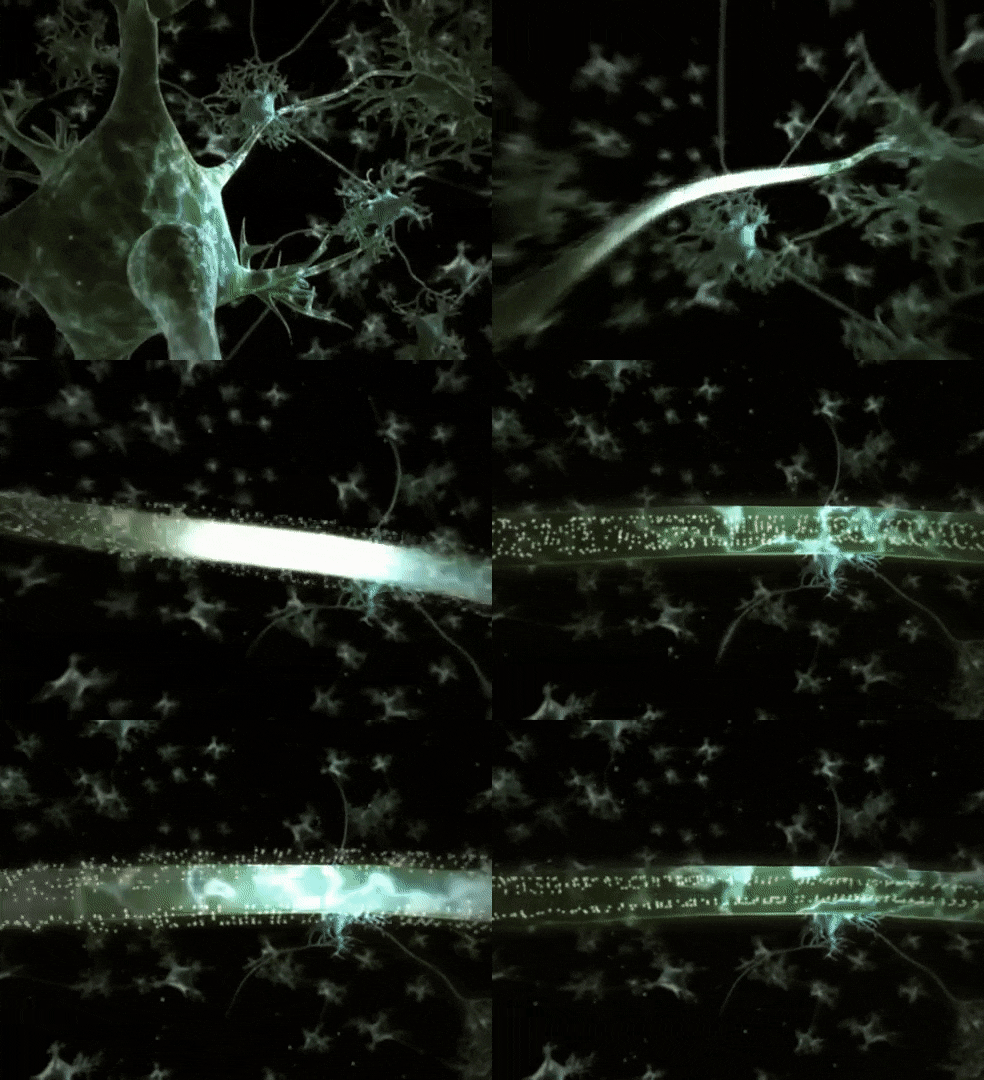
Our brains are famously flexible, or “plastic,” because neurons can do new things by forging new or stronger connections with other neurons. But if some connections strengthen, neuroscientists have reasoned, neurons must compensate lest they become overwhelmed with input. In a new study in Science, researchers at the Picower Institute for Learning and Memory at MIT …

seven facts about the brain that incline the mind to joy

The mind and the brain are mainly (and perhaps entirely) a single unified system Almost every – and perhaps every – subjective state is correlated with an objective, material brain state. Other than a transcendental factor – call it God, Spirit, Energy, or by whatever name – by definition, what else could be going on …

buddha’s brain: neuroplasticity and meditation

In a recent visit to the United States, the Dalai Lama gave a speech at the Society for Neuroscience's annual meeting in Washington, D.C. Over the past several years, he has helped recruit Tibetan Buddhist monks for, and directly encouraged research on the brain and meditation in the Waisman Laboratory for Brain Imaging and Behavior …

vagal pathways: portals to compassion

Contemplative practices are conceptualized as methods that function as neural exercises enhancing vagal regulation of the autonomic nervous system. The model presented proposes that specific voluntary behaviors (e.g., breath, vocalizations, and posture), which characterize ancient rituals and form the core of contemplative practices, can trigger a physiological state mediated by vagal pathways that fosters health …

the year of living creatively

"The privilege of a lifetime is being who you are." - Joseph Campbell During the past 50 years, quite a few researchers, social scientists, and psychologists have written passionately about the creative process, offering a number of models to help clarify its various stages. All of their models are deeply considered and relatively easy to understand. …

is meditation the reason this monk’s brain is eight years younger than his body?

While there's no fountain of youth, a Tibetian Buddhist monk may have tapped into the next best thing, according to an analysis showing that his 41-year-old brain actually resembles that of a 33-year-old.  The monk, Yongey Mingyur Rinpoche (YMR), a renowned meditation practitioner and teacher, began meditating at age 9. The "extraordinary number of hours" …