
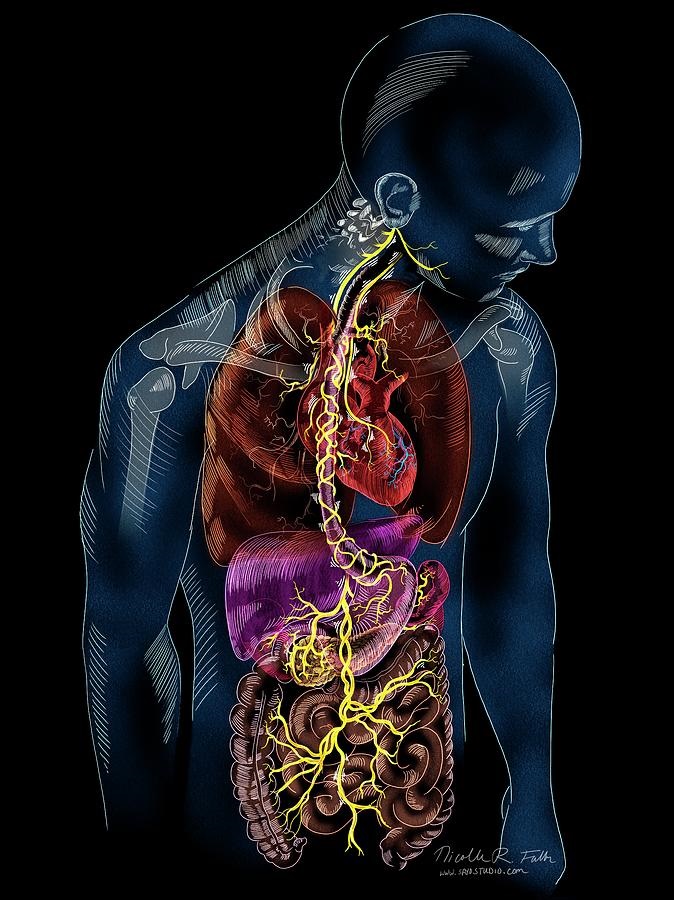
The vagus nerve is a modulator of intestinal immune homeostasis. The gastrointestinal tract is constantly confronted with food antigens, possible pathogens, and symbiotic intestinal microbiota that present a risk factor for intestinal inflammation (63). It is highly innervated by vagal fibers that connect the CNS with the intestinal immune system, making vagus a major component, the neuroendocrine-immune axis. This axis is involved in coordinated neural, behavioral, and endocrine responses, important for the first-line defense against inflammation (64). For example, in response to pathogens and other injurious stimuli, tumor-necrosis factor-alpha (TNF-α), a cytokine, is produced by activated macrophages, dendritic cells, and other cells in the mucosa (3, 65). Together with prostaglandins and interferons, TNF-α is an important mediator of local and systemic inflammation and increases cause the cardinal clinical signs of inflammation, including heat, swelling, pain, and redness (66, 67). Counter-regulatory mechanisms, such as immunologically competent cells and anti-inflammatory cytokines normally limit the acute inflammatory response and prevent the spread of inflammatory mediators into the bloodstream. Further, there is a “hard-wired” connection between the nervous and immune system functions as an anti-inflammatory mechanism. The dorsal vagal complex, comprising the sensory nuclei of the solitary tract, the area postrema, and the dorsal motor nucleus of the vagus, responds to increased circulating amounts of TNF-α by altering motor activity in the vagus nerve (68).
three pathways
The anti-inflammatory capacities of the vagus nerve are mediated through three different pathways (18). The first pathway is the HPA axis, which has been described above. The second pathway is the splenic sympathetic anti-inflammatory pathway, where the vagus nerve stimulates the splenic sympathetic nerve. Norepinephrine (NE) (noradrenaline) released at the distal end of the splenic nerve links to the β2 adrenergic receptor of splenic lymphocytes that release ACh. Finally, ACh inhibits the release of TNF-α by spleen macrophages through α-7-nicotinic ACh receptors. The last pathway, called the cholinergic anti-inflammatory pathway (CAIP), is mediated through vagal efferent fibers that synapse onto enteric neurons, which in turn release ACh at the synaptic junction with macrophages (18). ACh binds to α-7-nicotinic ACh receptors of those macrophages to inhibit the TNF-α (69). Compared to the HPA axis, the CAIP has some unique properties, such as a high speed of neural conductance, which enables an immediate modulatory input to the affected region of inflammation (70). Therefore, the CAIP plays a crucial role in the intestinal immune response and homeostasis, and presents a highly interesting target for the development of novel treatments for inflammatory diseases related to the gut immune system (6, 18).
The inflammation-sensing and inflammation-suppressing functions outlined above provide the principal components of the inflammatory reflex (71). The appearance of pathogenic organisms activates innate immune cells that release cytokines. These in turn activate sensory fibers that ascend in the vagus nerve to synapse in the nucleus tractus solitarius. Increased efferent signals in the vagus nerve suppress peripheral cytokine release through macrophage nicotinic receptors and the CAIP. Thus, experimental activation of the CAIP by direct electrical stimulation of the efferent vagus nerve inhibits the synthesis of TNF-α in liver, spleen, and heart, and attenuates serum concentrations of TNF-α (72, 73).
vagus nerve stimulation
Vagus nerve stimulation is a medical treatment that is routinely used in the treatment of epilepsy and other neurological conditions. VNS studies are not just clinically, but also scientifically informative regarding the role of the vagus nerve in health and disease.
device and method
Vagus nerve stimulation works by applying electrical impulses to the vagus nerve. The stimulation of the vagus nerve can be performed in two different ways: a direct invasive stimulation, which is currently the most frequent application and an indirect transcutaneous non-invasive stimulation. Invasive VNS (iVNS) requires the surgical implantation of a small pulse generator subcutaneously in the left thoracic region. Electrodes are attached to the left cervical vagus nerve and are connected to the pulse generator by a lead, which is tunneled under the skin. The generator delivers intermittent electrical impulses through the vagus nerve to the brain (74). It is postulated that these electrical impulses exert antiepileptic (75), antidepressive (76), and anti-inflammatory effects by altering the excitability of nerve cells. In contrast to iVNS, transcutaneous VNS (tVNS) allows for a non-invasive stimulation of the vagus nerve without any surgical procedure. Here, the stimulator is usually attached to the auricular concha via ear clips and delivers electrical impulses at the subcutaneous course of the afferent auricular branch of the vagus nerve (77). A pilot study that examined the application of VNS in 60 patients with treatment-resistant depressive disorder showed a significant clinical improvement in 30–37% of patients and a high tolerability (78). Five years later, the stimulation of the vagus nerve for the treatment of refractory depression was approved by the U.S. Food and Drug Administration (FDA) (79). Since then, the safety and efficacy of VNS in depression has been demonstrated in numerous observational studies as can be seen below. In contrast, there is no randomized, placebo-control clinical trial that reliably demonstrates antidepressant effects of VNS.
neural mechanism of VNS
The mechanism by which VNS may benefit patients nonresponsive to conventional antidepressants is unclear, with further research needed to clarify this (80). Functional neuroimaging studies have confirmed that VNS alters the activity of many cortical and subcortical regions (81). Through direct or indirect anatomic connections via the NTS, the vagus nerve has structural connections with several mood regulating limbic and cortical brain areas (82). Thus, in chronic VNS for depression, PET scans showed a decline in resting brain activity in the ventromedial prefrontal cortex (vmPFC), which projects to the amygdala and other brain regions modulating emotion (83). VNS results in chemical changes in monoamine metabolism in these regions possibly resulting in antidepressant action (84, 85). The relationship between monoamine and antidepressant action has been shown by various types of evidence. All drugs that increase monoamines—serotonin (5-HT), NE, or dopamine (DA)—in the synaptic cleft have antidepressant properties (86). Accordingly, depletion of monoamines induces depressive symptoms in individuals who have an increased risk of depression (87).
Chronic VNS influences the concentration of 5-HT, NE, and DA in the brain and in the cerebrospinal fluid (88). In rats, it has been shown that VNS treatments induce large time-dependent increases in basal neuronal firing in the brainstem nuclei for serotonin in the dorsal raphe nucleus (89). Thus, chronic VNS was associated with increased extracellular levels of serotonin in the dorsal raphe (90).
Several lines of evidence suggest that NE is a neurotransmitter of major importance in the pathophysiology and treatment of depressive disorders (91). Thus, experimental depletion of NE in the brain led to a return of depressive symptoms after successful treatment with NE antidepressant drugs (91). The LC contains the largest population of noradrenergic neurons in the brain and receives projections from NTS, which, in turn, receives afferent input from the vagus nerve (92). Thus, VNS leads to an enhancement of the firing activity of NE neurons (93), and consequently, an increase in the firing activity of serotonin neurons (94). Thus, VNS was shown to increase the NE concentration in the prefrontal cortex (95). The pharmacologic destruction of noradrenergic neurons resulted in the loss of antidepressant VNS effects (96).
In case of DA, it has been shown that the short-term effects (14 days) (94) and the long-term effects (12 months) (97) of VNS in treatment of resistant major depression may lead to brainstem dopaminergic activation. DA is a catecholamine that to a large extent is synthesized in the gut and plays a crucial role in the reward system in the brain (98).
Further, beneficial effects of VNS might be exerted through a monoamine-independent way. Thus, VNS treatments might result in dynamic changes of monoamine metabolites in the hippocampus (93) and several studies reported the influence of VNS on hippocampal neurogenesis (99, 100). This process has been regarded as a key biological process indispensable for maintaining the normal mood (101).
Serotonin is also an important neurotransmitter in the gut that can stimulate peristalsis and induce nausea and vomiting by activating the vagus nerve. In addition, it is essential for the regulation of vital functions, such as appetite and sleep, and contributes to feelings of well-being. To 95%, it is produced by enterochromaffin cells, a type of neuroendocrine cell which reside alongside the epithelium lining the lumen of the digestive tract (102). Serotonin is released from enterochromaffin cells in response to mechanical or chemical stimulation of the gastrointestinal tract which leads to activation of 5-HT3 receptors on the terminals of vagal afferents (103). 5-HT3 receptors are also present on the soma of vagal afferent neurons, including gastrointestinal vagal afferent neurons, where they can be activated by circulating 5-HT. The central terminals of vagal afferents also exhibit 5-HT3 receptors that function to increase glutamatergic synaptic transmission to second order neurons of the nucleus tractus solitarius within the brainstem. As a result, interactions between the vagus nerve and serotonin systems in the gut and in the brain appear to play an important role in the treatment of psychiatric conditions.
vagus-related treatment of depression
basic pathophysiology of depression
Major depressive disorder ranks among the leading mental health causes of the global burden of disease (104). With a lifetime prevalence of 1.0% (Czech Republic) to 16.9% (US) (105), the cost of depression poses a significant economic burden to our society (106). The pathophysiology of depression is complex and includes social environmental stress factors; genetic and biological processes, such as the overdrive of the HPA axis, inflammation (31), and disturbances in monamine neurotransmission as described above (91). For example, a lack of the amino acid tryptophan, which is a precursor to serotonin, can induce depressive symptoms, such as depressed mood, sadness, and hopelessness (86).
The overdrive of the HPA axis is most consistently seen in subjects with more severe (i.e., melancholic or psychotic) depression, when the cortisol feedback inhibitory mechanisms are impaired, contributing to cytokine oversecretion (107). It has been shown that chronic exposure to elevated inflammatory cytokines can lead to depression (108). This might be explained by the fact that cytokine overexpression leads to a reduction of serotonin levels (109). In line with that, treatment with anti-inflammatory agents has the potential to reduce depressive symptoms (110). In line, IBD are important risk factor for mood and anxiety disorders (111), and these psychiatric conditions increase the risk of exacerbation of IBD (112).
VNS in depression
A European multicenter study demonstrated a positive effect of VNS on depressive symptoms, in patients with treatment-resistant depression (113). The application of VNS over a period of 3 months resulted in a response rate of 37% and a remission rate of 17%. After 1 year of treatment, the response rate reached 53% and the remission rate reached 33%. A meta analysis that compared the application of VNS to the usual treatment in depressed patients showed a response rate of approximately 50% in the acute phase of the disease and a long-term remission rate of 20% after 2 years of treatment (114). Several other studies also demonstrated an increasing long-term benefit of VNS in recurrent treatment-resistant depression (84, 85, 115). Further, a 5-year prospective observational study which compared the effects of treatment as usual and VNS as adjunctive treatment with treatment as usual only in treatment-resistant depression, showed a better clinical outcome and a higher remission rate in the VNS group (116). This was even the case in patients with comorbid depression and anxiety who are frequent non-responders in trials on antidepressant drugs. It is important to note that all these studies were open-label and did not use a randomized, placebo-controlled study design.
Patients with depression have elevated plasma and cerebrospinal fluid concentrations of proinflammatory cytokines. The benefit of VNS in depression might be due to the inhibitory action on the production of proinflammatory cytokines (117) and marked peripheral increases in anti-inflammatory circulating cytokines (118). Further, improvement after VNS was associated with altered secretion of CRH, thus preventing the overdrive the HPA axis (119). Altered CRH production and secretion might result from a direct stimulatory effect, transmitted from the vagus nerve through the NTS to the paraventricular nucleus of the hypothalamus. Finally, VNS has been shown to inhibit peripheral blood production of TNF-α which is increased in clinical depression (10).
influence of nutrition on depressive symptoms
The gut microbiota is the potential key modulator of the immune (120) and the nervous systems (121). Targeting it could lead to a greater improvement in the emotional symptoms of patients suffering from depression or anxiety. There is growing evidence that nutritional components, such as probiotics (122, 123), gluten (124), as well as drugs, such as anti-oxidative agents (125) and antibiotics (126), have a high impact on vagus nerve activity through the interaction with the gut microbiota and that this effect varies greatly between individuals. Indeed, animal studies have provided evidence that microbiota communication with the brain involves the vagus nerve and this interaction can lead to mediating effects on the brain and subsequently, behavior (127). For example, Lactobacillus-species have received tremendous attention due to their use as probiotics and their health-promoting properties (128). Bravo et al. (129) demonstrated that chronic treatment of mice with Lactobacillus rhamnosus (strain JB-1) caused a reduction in stress-induced corticosterone levels and in anxiety-like and depression-like behavior (129). It has been shown that chronic treatment with L. rhamnosus (JB-1) induced region-dependent alterations in GABA(B1b) mRNA in the brain with increases in cortical regions (cingulate and prelimbic) and concomitant reductions in expression in the hippocampus, amygdala, and LC. In addition, L. rhamnosus (JB-1) reduced GABA(Aα2) mRNA expression in the prefrontal cortex and amygdala, but increased GABA(Aα2) in the hippocampus (129), which counteracts the typical pathogenesis of depressive symptoms: lack of prefrontal control and overactivity of subcortical, anxiogenic brain regions. Importantly, L. rhamnosus (JB-1) reduced stress-induced corticosterone and anxiety- and depression-related behavior. This is not surprising, since alterations in central GABA receptor expression are implicated in the pathogenesis of anxiety and depression (130, 131). The antidepressive and anxiolytic effects of L. rhamnosus were not observed in vagotomized mice, identifying the vagus as a major modulatory constitutive communication pathway between the bacteria exposed to the gut and the brain (129). In line with that, in a model of chronic colitis associated to anxiety-like behavior, the anxiolytic effect obtained with a treatment with Bifidobacterium longum, was absent in mice that were vagotomized before the induction of colitis (132).
In humans, psychobiotics, a class of probiotics with anti-inflammatory effects might be useful to treat patients with psychiatric disorders due to their antidepressive and anxiolytic effects (133). Differences in the composition of the gut microbiota in patients with depression compared with healthy individuals have been demonstrated (134). Importantly, the fecal samples pooled from five patients with depression transferred into germ-free mice, resulted in depressive-like behavior.
influence of relaxation techniques on depressive symptoms
It has been shown that self-generated positive emotions via loving-kindness meditation lead to an increase in positive emotions relative to the control group, an effect moderated by baseline vagal tone (135). In turn, increased positive emotions produced increases in vagal tone, which is probably mediated by increased perceptions of social connections. Individuals suffering from depression, anxiety, and chronic pain have benefited from regular mindfulness meditation training, demonstrating a remarkable improvement in symptom severity (9).
Controlled studies have found yoga-based interventions to be effective in treating depression ranging from mild depressive symptoms to major depressive disorder (MDD) (136). Some yoga practices can directly stimulate the vagus nerve, by increasing the vagal tone leading to an improvement of autonomic regulation, cognitive functions, and mood (137) and stress coping (138). The proposed neurophysiological mechanisms for the success of yoga-based therapies in alleviating depressive symptoms suggest that yoga breathing induces increased vagal tone (139). Many studies demonstrate the effects of yogic breathing on brain function and physiologic parameters. Thus, Sudarshan Kriya Yoga (SKY), a breathing-based meditative technique, stimulates the vagus nerve and exerts numerous autonomic effects, including changes in heart rate, improved cognition, and improved bowel function (140). During SKY, a sequence of breathing techniques of different frequencies, intensities, lengths, and with end-inspiratory and end-expiratory holds creates varied stimuli from multiple visceral afferents, sensory receptors, and baroreceptors. These probably influence diverse vagal fibers, which in turn induce physiologic changes in organs, and influence the limbic system (140). A recent study showed that even patients who did not respond to antidepressants showed a significant reduction of depressive and anxiety symptoms compared to the control group after receiving an adjunctive intervention with SKY for 8 weeks (141).
Iyengar yoga has been shown to decreased depressive symptoms in subjects with depression (142). Iyengar yoga is associated with increased HRV, supporting the hypothesis that yoga breathing and postures work in part by increasing parasympathetic tone (143).
vagus-related treatment of PTSD
pathophysiology of PTSD
Posttraumatic stress disorder is an anxiety disorder that can develop after trauma and is characterized by experiencing intrusive memories, flashbacks, hypervigilance, nightmares, social avoidance, and social dysfunctions (144). It has a lifetime prevalence of 8.3% using the definition for DSM-5 (145). The symptoms of PTSD can be classified into four clusters: intrusion symptoms, avoidance behavior, cognitive and affective alterations, and changes in arousal and reactivity (146). People who suffer from PTSD tend to live as though under a permanent threat. They exhibit fight and flight behavior or a perpetual behavioral shutdown and dissociation, with no possibility of reaching a calm state and developing positive social interactions. Over time, these maladaptive autonomic responses lead to the development of an increased risk for psychiatric comorbidities, such as addiction and cardiovascular diseases (147).
Posttraumatic stress disorder symptoms are partly mediated by the vagus nerve. There is evidence for diminished parasympathetic activity in PTSD, indicating an autonomic imbalance (148). The vagal control of heart rate via the myelinated vagal fibers varies with respiration. Thus, the vagal influence on the heart can be evaluated by quantifying the amplitude of rhythmic fluctuations in heart rate—respiratory sinus arrhythmia (RSA). A recent study has demonstrated a reduced resting RSA in veterans with PTSD (149). Further, patients with PTSD have been shown to have lower high-frequency heart rate variability than healthy controls (150).
Continuous expression of emotional symptoms to conditioned cues despite the absence of additional trauma is one of the many hallmarks of PTSD. Behavioral therapies employed to treat PTSD rely on helping the patient to gradually reduce her/his fear of this cue over time. Thus, exposure-based therapies are considered the gold standard of treatment for PTSD (151). The goal of exposure-based therapies is to replace conditioned associations of the trauma with new, more appropriate associations which compete with fearful associations. Studies have shown that PTSD patients exhibit deficient extinction recall along with dysfunctional activation of the fear extinction network (152, 153). This network includes the vmPFC, the amygdala, and the hippocampus. It is highly important for the contextual retrieval of fear memories after extinction (154).
Posttraumatic stress disorder symptom severity and structural abnormalities in the anterior hippocampus and centromedial amygdala have been associated (155). There is evidence for increased activation of the amygdala in humans and rodents during conditioned fear (156). The amygdala and the vmPFC have reciprocal synaptic connections (157). Indeed, under conditions of uncertainty and threat, the PFC can become hypoactive leading to a failure to inhibit overactivity of the amygdala with emergence of PTSD symptoms, such as hyperarousal and re-experiencing (158). Further, in response to stressful stimuli as fearful faces, patients with PTSD showed a higher activation of the basolateral amygdala during unconscious face processing compared to healthy controls as well as patients with panic disorder and generalized anxiety disorder (159).
The hippocampus is also a crucial component of the fear circuit and implicated in the pathophysiology of PTSD. Patients with PTSD show a reduced hippocampal volume that is associated with symptom severity (160). The hippocampus is a key structure in episodic memory and spatial context encoding. Hippocampal damage leads to deficits in context encoding in humans as well as rodents. The neural circuit consisting of the hippocampus, amygdala, and vmPFC is highly important for the contextual retrieval of fear memories after extinction (154). Impairment of hippocampal functioning, resulting dysfunctional context generalization in patients with PTSD, might cause patients to re-experience trauma-related symptoms (161).
VNS in PTSD
Vagus nerve stimulation has shown promise as therapeutic option in treatment-resistant anxiety disorders, including PTSD (8). Chronic VNS has been shown to reduce anxiety in rats (96) and improve scores on the Hamilton Anxiety Scale in patients suffering from treatment-resistant depression (8). When stimulated, the vagus nerve sends signals to the NTS (162) and the NTS sends direct projections to the amygdala and the hypothalamus. Further, VNS increases the release of NE in basolateral amygdala (163) as well as the hippocampus and cortex (93). NE infusion in the amygdala results in better extinction learning (164). Thus, VNS could be a good tool to increase extinction retention. For example, in rats, extinction paired with VNS treatment can lead to remission of fear and improvements in PTSD-like symptoms (151). Further, VNS paired with extinction learning facilitates the plasticity between the infralimbic medial prefrontal cortex and the basolateral complex of the amygdala to facilitate extinction of conditioned fear responses (165). Additionally, VNS may also enhance extinction by inhibiting activity of the sympathetic nervous system (119). It is possible that an immediate VNS-induced reduction in anxiety contributes to VNS-driven extinction by interfering with the sympathetic response to the CS, thus breaking the association of the CS with fear. However, there is need for randomized controlled trials to approve these observations.
One of the most consistent neurophysiological effects of VNS is decreasing the hippocampal activity, possibly through enhancement of GABAergic signaling (166). As described above, the hippocampus is a crucial component of the fear circuit, since it is a key structure in episodic memory and spatial context encoding. Decreased hippocampal activity after VNS has been reported in a number of other studies in other conditions such as depression (77, 167) or schizophrenia (168).
positive Influence of nutritive components on PTSD
Emerging research suggests that probiotics may have the potential to decrease stress-induced inflammatory responses, as well as associated symptoms. An exploratory study that investigated the microbiome of patients with PTSD and trauma exposed controls revealed a decreased existence of three bacteria strains in patients with PTSD: Actinobacteria, Lentisphaerae, and Verrucomicrobia that were associated with higher PTDS symptom scores. These bacteria are important for immune regulation and their decreased abundance could have contributed to a dysregulation of the immune system and development of PTSD symptoms (169). A study using a murine model of PTSD (170) has demonstrated that immunization with a heat-killed preparation of the immunoregulatory bacterium Mycobacterium vaccae (NCTC 11659) induced a more proactive behavioral response to a psychosocial stressor (171). Studies performed in healthy volunteers have shown that the administration of different probiotics were associated with an improved well-being (172–174), as well as a decrease in anxiety and psychological distress (174, 175). These findings are all preliminary. There is an urgent need for well-designed, double-blind, placebo-controlled clinical trials aimed at determining the effect of bacterial supplements and controlled changes in diet on psychological symptoms and cognitive functions in patients with PTSD.
positive influence of meditation and yoga on PTSD
There is clinical evidence for the efficacy of mindfulness-based stress reduction (MBSR) in the treatment of PTSD (176–178). During MBSR, slow breathing and long exhalation phases lead to an increase in parasympathetic tone (179). In addition, clinical studies have demonstrated the effectiveness of yoga as a therapeutic intervention for PTSD and dissociation through a downregulation of the stress response (180–182). Yoga practices also decreased symptoms in PSTD after natural disasters (183, 184). Yoga-responsive anxiety disorders, including PTSD, go together with low HRV and low GABA activity (139). The interactions of the PFC, hippocampus, and amygdala in conjunction with inputs from the autonomous nervous system and GABA system provide a network through which yoga-based practices may decrease symptoms (185). There are indications that impaired extinction of conditioned fear in PTSD is associated with decreased vmPFC control over amygdala activity (157). PFC activation associated with increased parasympathetic activity during yoga could improve inhibitory control over the amygdala via PFC GABA projections, decreasing amygdala overactivity, and reducing PTSD symptoms.
Funding
This work was supported by the University of Bern. For full reference list see https://www.frontiersin.org/articles/10.3389/fpsyt.2018.00044/full
Acknowledgments
The authors gratefully acknowledge Sarah Steinau for her contributions to this article.
 Neurosoma